
The Foundation Crisis: Why Hiring AI Specialists Before Data Engineers is Setting Companies Up for Failure
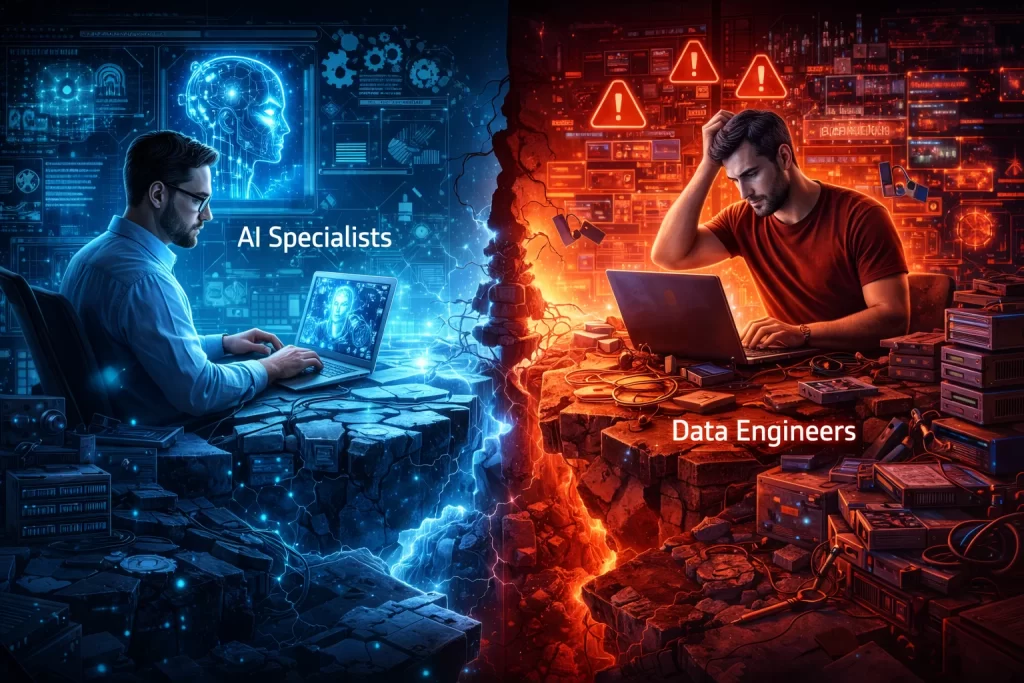
In the rush to embrace artificial intelligence, organizations are making a critical mistake that could cost them millions in failed projects and lost opportunities. Recent employment data reveals a troubling trend: companies are hiring AI specialists at unprecedented rates while neglecting the foundational data infrastructure roles that make AI success possible. It’s akin to hiring race car drivers before building the race track—impressive on paper, but destined for failure.
The Alarming Statistics Behind AI Project Failures
The numbers paint a stark picture of the current state of AI implementation in enterprise environments. According to RAND research, more than four in five AI projects fail to deliver on their promises. This failure rate—exceeding 80%—is approximately double that of traditional technology projects, raising serious questions about how organizations approach AI adoption.
What’s driving these failures? The answer isn’t found in the sophistication of AI models or the capabilities of machine learning algorithms. Instead, the culprit lies in something far more fundamental: the quality, accessibility, and governance of the data feeding these systems. Nearly two-thirds (63%) of organizations admit they lack confidence in their data management capabilities for AI initiatives, yet hiring patterns suggest many haven’t connected these dots.
Recent US employment data from DoubleTrack provides concrete evidence of this misalignment. Between 2024 and 2025, American employers posted 111,296 positions for AI and machine learning specialists, but only 76,271 roles focused on data infrastructure. This 46% gap between AI roles and data engineering positions represents a fundamental misunderstanding of what makes AI projects succeed.
The “Hiring Robots Before Mechanics” Phenomenon
This hiring imbalance can be understood through a simple analogy: companies are essentially hiring robots before ensuring they have mechanics to maintain them. AI specialists are the visible, exciting face of digital transformation—the innovators who promise to revolutionize business processes and unlock new revenue streams. Data engineers, by contrast, work behind the scenes, building the pipelines, ensuring data quality, and maintaining the infrastructure that makes AI possible.
The problem manifests differently across industries, but the pattern remains consistent. In sales departments, companies posted 232% more AI roles than data infrastructure positions. This is particularly concerning given that customer relationship management (CRM) data is notoriously messy, inconsistent, and fragmented. Sales data often contains duplicate records, inconsistent formatting, incomplete information, and conflicting entries across systems—exactly the kind of data quality issues that doom AI projects from the start.
Marketing departments show a more balanced approach but still favor AI roles by 54%. While this is better than sales, it still represents a concerning prioritization of AI capabilities over the data quality work needed to support those capabilities effectively.
Engineering, legal, and technology sectors all demonstrated similar patterns, with AI hiring consistently outpacing data infrastructure hiring. Each of these departments generates and relies on different types of data with unique quality challenges, yet the hiring emphasis remains on AI implementation rather than data foundation building.
The Geography of AI Hype: Where the Problem is Most Acute
Geography tells an interesting story about who’s making this mistake most severely. The states with the highest ratios of AI roles to data infrastructure roles aren’t the traditional technology hubs like California, New York, or Massachusetts. Instead, they’re regions generally perceived as less technologically mature:
- Mississippi leads with a staggering 264% more AI roles than data positions
- Missouri follows at 179%
- Kansas shows a 176% imbalance
- Montana registers 175% more AI than data roles
This geographic distribution suggests that regions with less established technology ecosystems may be more susceptible to AI hype, rushing to hire specialists without first building the necessary infrastructure. These areas may lack experienced leadership who understand that AI success depends on data quality, or they may be pressured to appear innovative without fully understanding the technical requirements.
More established technology centers, while still showing imbalances, tend to have better ratios. This likely reflects deeper institutional knowledge about the realities of implementing complex technology systems and the importance of foundational infrastructure.
The Compensation Conundrum
Making this situation more problematic, AI specialists command an average salary premium of approximately $15,000 over data engineers. Organizations are paying more for professionals who cannot deliver results without proper foundations in place. This compensation gap signals to the market that AI work is more valuable than data engineering, driving talent away from foundational roles and reinforcing organizational biases that favor exciting, visible AI work over crucial data infrastructure.
Understanding Why This Happens
Several factors contribute to this widespread misalignment between hiring priorities and actual technical requirements:
The Visibility Problem
AI projects are highly visible. When an organization announces a new AI initiative, it generates excitement among stakeholders, impresses investors, and creates compelling marketing narratives. Data infrastructure projects, by contrast, are invisible to most stakeholders. Building robust data pipelines, implementing governance frameworks, and ensuring data quality don’t make for exciting press releases.
The Complexity Misunderstanding
Many decision-makers underestimate the complexity of data engineering work. They may view it as simple ETL (Extract, Transform, Load) processes that can be handled quickly, while seeing AI as requiring specialized expertise. In reality, modern data engineering is extraordinarily complex, involving distributed systems, real-time processing, data quality frameworks, governance implementation, and integration across diverse systems and formats.
The Expertise Gap in Leadership
Many executives making hiring and budget decisions don’t have technical backgrounds that give them insight into the data requirements for successful AI. They may have read about AI’s transformative potential in business publications but lack understanding of the technical prerequisites. This knowledge gap leads to decisions that prioritize the exciting outcome (AI) over the necessary foundation (data infrastructure).
The Pressure to Appear Innovative
Organizations face intense pressure to appear innovative and forward-thinking. Hiring AI specialists signals innovation in a way that hiring data engineers does not. This is especially true for companies in competitive markets or those trying to attract investment. The optics of AI hiring often take precedence over the practical requirements for success.
The Real-World Consequences
The consequences of this inverted hiring priority extend far beyond failed pilot projects. Organizations are experiencing several serious impacts:
Wasted Investment
When AI projects fail due to poor data foundations, organizations waste significant investments not just in the AI specialists’ salaries, but in the entire ecosystem built around those specialists—cloud infrastructure, software licenses, training programs, and opportunity costs. These failed projects can cost millions while delivering zero business value.
Talent Frustration and Turnover
Talented AI specialists who join organizations expecting to do innovative work quickly become frustrated when they discover they’re hamstrung by poor data quality. They may find themselves spending 80% of their time on data cleaning and preparation—work they’re overqualified for and didn’t sign up to do. This leads to poor job satisfaction and higher turnover, creating a vicious cycle of hiring, losing talent, and hiring again.
Competitive Disadvantage
While organizations struggle with failed AI initiatives built on shaky data foundations, competitors who invested properly in data infrastructure are achieving real results. These competitors can iterate faster, deploy more sophisticated models, and achieve genuine business outcomes, leaving the AI-first-data-later companies increasingly far behind.
Organizational Disillusionment
Repeated AI project failures breed cynicism within organizations. Teams become skeptical of new initiatives, executives lose faith in technology investments, and the organization develops antibodies against innovation. This cultural damage can persist long after the technical issues are resolved.
The Path Forward: Building Data-First AI Strategies
The solution to this crisis isn’t to stop hiring AI specialists entirely—organizations need both AI expertise and data engineering capabilities. However, the sequencing and proportions matter enormously. Here’s how organizations can build more sustainable AI capabilities:
Start with Data Assessment
Before hiring a single AI specialist, organizations should conduct a thorough assessment of their current data landscape. This assessment should evaluate data quality across key systems, data accessibility and integration capabilities, governance frameworks and policies, technical infrastructure for data processing, and gaps between current state and AI readiness.
This assessment provides a roadmap for what needs to be built before AI initiatives can succeed and helps prioritize data infrastructure investments.
Establish Proper Hiring Ratios
Rather than the 46% imbalance seen in current US employment data, organizations should aim for at least parity between data engineering and AI roles in the early stages of building capabilities. A more appropriate ratio might be 2:1 or even 3:1 data engineers to AI specialists until robust data infrastructure is established.
This doesn’t mean AI hiring should stop, but it should be proportional to the data engineering capacity that exists to support it.
Invest in Data Governance Early
Data governance isn’t just about compliance—it’s about ensuring that data is reliable, consistent, and trustworthy enough to train AI models on. Organizations should establish data governance frameworks before launching AI initiatives, including clear data ownership and accountability, data quality standards and monitoring, metadata management practices, lineage tracking capabilities, and security and privacy controls.
Create Cross-Functional Teams
The most successful AI implementations involve close collaboration between data engineers, AI specialists, domain experts, and business stakeholders. Rather than siloing AI teams, organizations should create integrated teams where data engineers and AI specialists work together from project inception through deployment and maintenance.
Prioritize Infrastructure Before Innovation
Organizations should resist the temptation to jump directly to cutting-edge AI techniques. Instead, they should first build robust data pipelines that can reliably collect, clean, and prepare data, implement data quality monitoring and alerting, establish scalable data storage and processing infrastructure, create self-service data access tools for analysts and data scientists, and ensure data security and compliance frameworks are in place.
Only after these foundations exist should organizations pursue ambitious AI initiatives.
Educate Leadership
Perhaps most importantly, organizations need to educate their leadership about the technical realities of AI implementation. This education should cover how AI models depend on data quality, why data engineering is a prerequisite for AI success, the typical timeline and investment required for building data infrastructure, and the risks of prioritizing AI hiring over data engineering.
When executives understand these fundamentals, they’re more likely to make decisions that lead to successful outcomes.
The Role of AI Maturity Models
Organizations should adopt AI maturity models that recognize data infrastructure as a prerequisite for advanced AI capabilities. Typical stages include:
Stage 1: Data Foundation – Establishing basic data collection, storage, and quality processes.
Stage 2: Analytics Capability – Building descriptive and diagnostic analytics that provide insights from existing data.
Stage 3: Predictive Analytics – Implementing models that predict future outcomes based on historical patterns.
Stage 4: Prescriptive Analytics – Developing systems that recommend actions based on predictions.
Stage 5: Autonomous Systems – Creating AI systems that make and implement decisions with minimal human intervention.
Organizations should honestly assess their current stage and resist skipping ahead. Attempting advanced initiatives at stage 1 data maturity guarantees failure.
Gartner’s Warning: The 2026 Cliff
Market research firm Gartner has issued a stark warning that supports the importance of proper data foundations: three in five AI projects without AI-ready data could be abandoned by 2026. This represents a massive waste of organizational resources and a significant setback for digital transformation initiatives.
The “AI-ready data” concept is crucial. It’s not enough to simply have data; that data must be clean, accessible, well-governed, properly integrated, secure and compliant, and sufficient in volume and variety for the intended AI applications.
Organizations that have focused on hiring AI specialists without ensuring their data meets these criteria are likely to find themselves part of the 60% abandonment statistic.
Industry-Specific Considerations
Different industries face unique challenges in building data foundations for AI. Financial institutions must balance innovation with strict regulatory requirements and data lineage tracking. Healthcare organizations need to enable AI while maintaining HIPAA compliance and unifying siloed patient data. Retailers require real-time data processing across online and offline channels. Manufacturing companies need robust IoT pipelines and OT/IT system integration for predictive maintenance and quality control.
Best Practices from Successful Organizations
Organizations that have successfully implemented AI share common characteristics: they started with specific, high-value use cases rather than trying to transform everything at once; invested heavily in data infrastructure before scaling AI initiatives; created cross-functional teams including data engineers, AI specialists, and domain experts; measured success based on business outcomes, not just model accuracy; and treated data quality as an ongoing discipline. These organizations understood that AI success is built on excellent data engineering foundations.
The Artezio Perspective: Building Sustainable AI Capabilities
At Artezio, we’ve observed these patterns firsthand across our client engagements. Organizations that approach us wanting to “do AI” often need to hear an uncomfortable truth: they’re not ready for AI yet. Their data infrastructure isn’t mature enough to support successful AI initiatives.
Our approach emphasizes foundation-first development. We help clients assess their current data maturity, build robust data infrastructure, implement governance frameworks, and only then develop AI capabilities that can actually deliver business value. This approach may take longer initially, but it results in sustainable capabilities that deliver real ROI.
We also recognize that successful AI implementation requires diverse skills. Our teams include data engineers, data architects, ML engineers, AI specialists, and domain experts. This multidisciplinary approach ensures that projects have both the foundational infrastructure and the specialized AI expertise needed for success.
Conclusion: Rethinking AI Hiring Priorities
The current imbalance in AI versus data engineering hiring represents a fundamental misunderstanding of what makes AI initiatives successful. Organizations are essentially trying to build houses starting with the roof—an approach that’s bound to collapse under its own weight.
The path forward requires honest assessment of current data maturity, strategic hiring that prioritizes data infrastructure roles, investment in data governance and quality, patient building of capabilities in the right sequence, and leadership education about technical realities.
Companies that continue hiring AI specialists without corresponding investment in data engineering will find themselves part of the 80% failure rate statistics. Those that recognize data infrastructure as the foundation for AI success will be the ones achieving real business outcomes and competitive advantages.
The question isn’t whether to invest in AI—it’s how to invest wisely by ensuring the foundations exist to support that investment. As Gartner’s research makes clear, organizations have until 2026 to get this right. After that, projects built on shaky data foundations will increasingly be abandoned, representing enormous wasted investments and lost opportunities.
The choice is clear: organizations can either chase AI hype by hiring specialists without infrastructure, or they can build sustainable capabilities by investing properly in data foundations. The organizations that choose the latter path will be the ones still standing—and succeeding—when the AI hype cycle inevitably corrects itself and results matter more than promises.
About Artezio
Artezio is a software development company that specializes in custom software solutions, with deep expertise in data engineering, analytics, and AI implementation. We help organizations build the foundational capabilities needed for successful digital transformation, ensuring that AI investments deliver real business value rather than just impressive demos. Contact us to learn how we can help your organization build sustainable data and AI capabilities.